Working design notes for SEN2024STARMADE, the Survivors Enclave StarMade server.
Status labels:
Proposed: design agreed in concept, not yet tested live.Ready to test: command path is plausible and should be tested in a controlled sector.Live: implemented and verified on the server.
Server Context
- Active instance:
SEN2024STARMADE - Active world:
survivors0 - Current indexed systems: 40
- Current world posture: small active/current world with legacy
world0archive nearby; treatworld0as archival unless explicitly restored.
Operating Principles
- Make game-director actions visible, documented, and reversible where practical.
- Prefer player-facing consequences over silent admin deletion.
- Keep economy-impacting or destructive actions behind explicit approval until tested.
- Separate public player access from GM/admin-only controls.
GM Faction And Public Outposts
Status: Proposed
Create a game-director faction that can own stations, shops, event structures, and public infrastructure without handing ownership to players.
Expected setup:
- Create a GM faction through admin commands.
- Spawn or load blueprint stations as faction-owned infrastructure.
- Place and configure faction modules for ownership.
- Keep public docks, shops, and service areas accessible to players.
- Protect admin storage, control blocks, and event systems with permissions.
Useful commands:
/faction_create <name> <description>
/faction_list
/faction_join_id <playerName> <factionId>
/faction_mod_member <playerName> <rank>
/load <catalogBlueprintName> <stationName>
Faction Shops
Status: Proposed
Use Shop Modules on GM or player faction stations to create controlled economy points.
Expected setup:
- Build or load a station.
- Claim it under the owning faction.
- Add a Shop Module.
- Stock the shop with blocks/items.
- Set buy/sell prices and desired quantities.
- Restrict access by public, allies, faction, or faction rank.
Admin support commands:
/give <playerName> <itemName> <count>
/giveid <playerName> <itemId> <count>
/shop_restock
/shop_restock_full
Blueprint Ship Broker
Status: Ready to test
Create a GM-run ship vendor that lets players buy complete ship blueprints or ship access from a curated list. This should feel like an NPC merchant in-world, even if the implementation is a faction-owned station, catalog terminal, shop module, and/or admin automation rather than a literal walking NPC.
Design:
- Build a public GM shipyard or broker station.
- Theme the vendor as an NPC faction representative, such as
SEN Ship Broker,Trading Guild Surplus, orJunkyard Reclamation Office. - Upload or expose curated ship blueprints through the server catalog.
- Put a Shop Module or service counter at the broker station.
- Restrict the available ships by progression tier, faction reputation, event unlocks, or price.
- Keep admin-only blueprint management areas protected.
Native path to test:
- Upload selected ships to the multiplayer/server catalog.
- Set catalog permissions so players can buy the approved entries.
- Require players to be near the broker/shop area to buy.
- Verify whether purchase immediately spawns the ship, unlocks the blueprint, or requires materials through shipyard/catalog construction on this server build.
Fallback concierge path:
- Player pays the listed price at the broker shop or to an admin-controlled account.
- Admin/game-director verifies payment.
- Admin loads the purchased blueprint near the shipyard.
Useful commands:
/list_ships
/load <catalogBlueprintName> <newShipName>
/give_credits <playerName> <count>
/server_message_to info <playerName> "<message>"
Important test questions:
- Can server catalog entries be priced and permissioned cleanly for public purchase?
- Does catalog purchase grant reusable blueprint access or a one-time spawned ship?
- Can a Shop Module directly support catalog ship buying in the desired way?
- Can blueprint purchases be limited by faction rank or only by catalog/shop permissions?
- What happens if the spawn area is blocked?
Recommended safeguards:
- Start with starter ships, haulers, miners, and salvage craft rather than combat-heavy ships.
- Keep prices high enough that mining, crafting, and salvaging still matter.
- Mark premium/event ships as limited or manually fulfilled until the economy is stable.
- Log each GM-loaded ship with buyer, blueprint, price, sector, and timestamp.
Spawn Megayard Free Repair Station
Status: Ready to test
Build a gigantic GM-owned repair station near spawn that can handle capital ships, including star-destroyer-scale builds. Repairs are free for players at the point of use, making spawn a reliable recovery hub after combat, exploration mistakes, or Deep Void junkyard recovery.
Design:
- Place the repair station near the spawn area, but far enough from the exact spawn point to avoid crowding new players.
- Own it through the GM/admin faction.
- Build an oversized Shipyard frame with clear approach lanes and a very large open drydock.
- Use one or more obvious docking/repair bays, with signage or station layout guiding players to the Shipyard Core Anchor.
- Keep the repair zone public, but protect control rooms, storage, shipyard computers, and cargo systems from player modification.
- Pair it thematically with the Blueprint Ship Broker and Deep Void Junkyard.
Technical model:
- StarMade shipyards are station-exclusive systems.
- A valid shipyard uses a Shipyard Computer, Shipyard Modules in a C shape, and a Shipyard Core Anchor.
- Damaged ships dock to the Shipyard Core Anchor.
- Repair happens through the Shipyard Computer by reconstructing the ship from a design.
- The process can replace missing blocks, but it may reset saved hotbar configurations.
Free repair model:
- Repairs are free for players.
- The GM faction absorbs the material cost.
- The shipyard should be stocked with a deep material reserve, or replenished manually/automatically by admins.
- If native shipyard repair requires player-supplied design/materials in this build, use the station as a free assisted repair service until automation is proven.
Important test questions:
- How large must the shipyard C-frame be to safely dock and repair the biggest ship we expect?
- Does a player need to provide their own design, or can the station/admin provide one?
- Can repair draw from station cargo, shipyard computer inventory, or linked storage?
- Can permissions allow public repair use without allowing players to edit the station?
- What happens if multiple large ships try to use the yard at once?
Recommended safeguards:
- No combat inside the repair yard sector.
- Add a repair queue or one-ship-at-a-time rule if players begin blocking the bay.
- Do not allow hostile/chased ships to abuse free repair mid-fight.
- Keep a separate admin bay for recovering stuck or bugged ships.
- Log large free repairs if they materially affect the economy or PvP balance.
Spawn Core Safe Zone
Status: Proposed
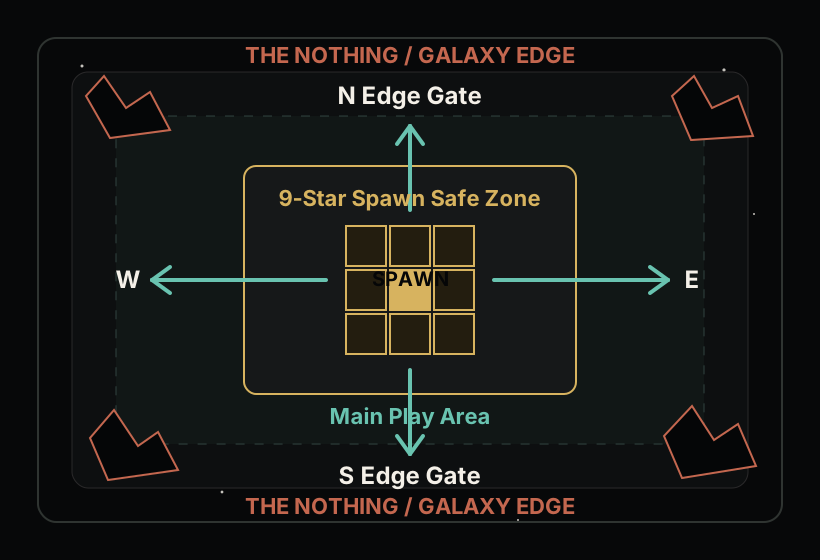
The 9 stars surrounding spawn should be the protected core of the campaign. Treat this as a 3x3 safe-zone cluster centered on the spawn star: the spawn system plus its eight neighboring star systems on the main play plane.
Design:
- Spawn, the megayard, ship broker, beginner services, and public gates live inside the core.
- The core is the social/economic recovery zone, not an endgame warzone.
The Nothingshould not spawn, expand, or attack inside the core.- Pirate Heat enforcement should not create base-pressure events inside the core unless manually approved by a GM.
- New players should be encouraged to start, repair, shop, and regroup inside the core before traveling outward.
Rules model:
- No harassment, spawn camping, or hostile blockades inside the safe-zone cluster.
- PvP inside the safe zone should be disabled by rule, sector protection, or GM enforcement wherever practical.
- Players can pass through, trade, dock, repair, and stage from the safe zone.
- Valuable endgame loot should come from outside the safe zone so the economy points outward.
Boundary model:
- Inner core: 9-star safe zone around spawn.
- Main play area: the livable band between the 9-star spawn safe zone and the galaxy edge.
- Galaxy edge: dangerous endgame space,
The Nothingactivity, rare loot, and higher risk.
Important test questions:
- What exact star/system coordinates make up the 3x3 spawn-core cluster?
- Can sector/system protections reliably enforce the safe-zone rules?
- Should player-owned bases be allowed inside the core, or should core ownership stay GM/public only?
- What exact edge-frontier staging coordinates should the four one-way cardinal gates use?
Anti-Harassment Pirate Heat System
Status: Proposed
Use escalating pirate pressure to discourage harassment while preserving normal PvP danger. The target cadence is that a player being attacked by another player roughly once every 3-4 days is acceptable, but repeated pressure against the same player or vulnerable players builds heat. Pirate response should be a delayed consequence against the offender's assets, not interference in the offender's active raid.
Core idea:
- Track aggression as incidents, not just kills.
- Use both per-attacker heat and attacker-victim pair heat.
- Let heat decay when the attacker stops hostile behavior.
- Escalate pirate response only when the pattern continues.
- Apply pirate pressure at the offender's base or holdings after the hostile incident, not at the victim's location during the raid.
- Keep exact thresholds private and variable so players cannot precisely game the system.
Baseline tolerance:
- One meaningful attack against the same player in a 72-96 hour window should usually be treated as normal PvP.
- Repeated attacks against the same player inside that window increase heat.
- Spawn camping, attacking new players, repair-yard abuse, repeated pursuit after disengagement, and targeting the same player through alts/friends increase heat faster.
- Declared wars, consensual duels, events, mutual faction battles, and clear retaliation should be exempt or reduced.
Variable controls:
- Detection window: randomized within a configured range, such as 72-96 hours.
- Warning threshold: hidden and adjustable by GM staff.
- Escalation threshold: hidden and adjusted by offender history.
- Cooldown/decay: heat drops over time when no new harassment incidents occur.
- Spawn timing: randomized delay after threshold crossing, preferably after the active player-vs-player encounter has ended.
- Spawn location: near the offender's base, home sector, faction holding, or owned station, not at the victim's location and not predictably at a fixed farm point.
- Fleet tier: scaled by offender ship class, repeat behavior, and recent escalation tier.
- Daily cap: maximum number of enforcement events per offender per day.
Escalation ladder:
- Warning: pirate scan, rumor, or direct GM-style message.
- Scout pressure: small pirate probe near the offender's base or travel route.
- Hunter pressure: stronger pirate wing attacks offender logistics, outposts, or base perimeter.
- Punitive pressure: heavy hunter group, bounty marker, blockade, or base-sector pressure.
- GM review: manual intervention, temporary protection, forced relocation, or discipline.
Base-pressure rule:
- Pirates should not join, assist, interrupt, or decide an active player raid.
- Pirates should not spawn on top of the victim or inside the contested raid sector just because harassment heat triggered.
- The offender's next consequence should land at their own base, staging area, home sector, or other owned asset.
- If the offender has no known base, target their last known staging sector or delay response until a valid offender asset is identified.
- Avoid automated pirate base-pressure events inside the 9-star spawn safe zone; escalate to GM review instead.
Anti-farming safeguards:
- Enforcement pirates should be low-reward by design.
- Do not load enforcement fleets with rare cargo, high-value blocks, or premium salvage.
- Use purpose-built pirate blueprints with minimal economic value relative to the effort required to kill them.
- Pirates should despawn, retreat, or stop escalating when the offender changes behavior and heat begins cooling.
- Killing enforcement pirates should not reduce harassment heat by itself.
- Repeatedly baiting pirates should increase farm-abuse heat or trigger GM review.
- Third parties should not receive rewards for farming another player's enforcement event.
- If possible, enforcement pirates should prefer the offender's owned assets, logistics, and active ship, not nearby uninvolved players.
- Do not reveal exact heat values or spawn formulas publicly.
Farm-abuse indicators:
- Same players repeatedly alternating attacker/victim roles.
- Low-damage staged attacks followed by pirate farming.
- Players luring enforcement fleets into prepared kill zones.
- Multiple players provoking one offender to generate pirates.
- Offender repeatedly crossing thresholds but suffering no real loss.
Implementation phases:
- Manual: admins log reports/incidents and spawn pirate response by judgment.
- Semi-automated: a watcher summarizes recent kills, sectors, victims, and offenders for GM review.
- Automated: watcher applies heat, sends warnings, and triggers approved pirate waves within configured limits.
Useful commands to test:
/server_message_to info <playerName> "<message>"
/spawn_mobs <catalogName> <factionId> <count>
/spawn_mobs_line <catalogName> <factionId> <count>
/initiate_wave <level> <seconds> <factionId>
Important test questions:
- Do server logs expose enough player-vs-player aggression detail for automation?
- Can we identify attacker, victim, sector, ship, and faction from logs or database state?
- Which pirate faction ID and catalog ships should represent enforcement pirates?
- Can spawned pirates be tuned to low/no profit while still being dangerous?
- Can pirate waves target the offender reliably enough to avoid collateral damage?
The Nothing Endgame Incursion
Status: Proposed
Create a separate hostile endgame NPC threat near the edge of the allowed galaxy. Working title: The Nothing. These are all-black ships representing an encroaching void force. Their job is to slowly pressure outer systems, destroy unattended or weak holdings, and create a repeatable endgame combat-and-economy loop.
Feasibility notes:
- StarMade supports multiple NPC faction entries in
data/npcFactions/npcSpawnConfig.xml. - The current server has default NPC faction data for
Outcasts,Scavengers, andTrading Guild. - The server also has NPC blueprint lanes under
blueprints-npc, includingpirate,neutral, andtrading-guild. - Current
server.cfghasENABLE_SIMULATION = true. - Current
server.cfghasNPC_FACTION_SPAWN_LIMIT = 0; this needs testing/adjustment before relying on additional native NPC faction spawning.
Core gameplay loop:
- Player starts at spawn.
- Player uses a protected gate from spawn to a frontier staging sector near the galaxy edge.
- Player hunts
The Nothingships and outposts. - Rare loot drops from these ships or is awarded for confirmed kills.
- Player returns to spawn through the gate.
- Player sells the rare loot to a GM/NPC buyer.
- Credits fund better ships, repairs, and progression through the Blueprint Ship Broker.
Threat identity:
- Ships should be visually all-black or nearly black.
- Silhouette should feel alien, simple, and menacing rather than pirate-like.
- Naming should communicate endgame danger:
Null Frigate,Black Tide Hunter,Void Harvester,Event Horizon Carrier,Nothing Dreadnought. - The faction should not behave like ordinary pirates or harassment enforcement pirates.
Frontier/gate design:
- Spawn has four clear public one-way outbound gates, one for each cardinal direction: north, east, south, and west.
- Each cardinal gate exits at a different edge-frontier staging sector near the galaxy boundary.
The Nothinglives at the edge of the galaxy, not in the main play area and not near spawn.- The edge-frontier staging sectors should be protected or heavily defended enough to prevent immediate gate camping.
- The normal play area sits between the spawn safe zone and these edge-frontier staging sectors.
- Beyond each staging sector, systems become dangerous endgame space controlled or contested by
The Nothing. - Return travel should use separate return gates, extraction points, or another approved return mechanic so outbound gates remain one-way.
- Frontier content should be opt-in: players choose a cardinal edge lane, travel outward, hunt, recover loot, and return to sell.
The Nothingshould not naturally breach the 9-star spawn safe zone without a deliberate GM event.
Encroachment model:
The Nothingstarts at the edge of the allowed galaxy, well outside the 9-star spawn safe zone.- It slowly expands inward or increases activity in outer systems.
- It can attack or degrade unattended outer holdings.
- GM events can announce incursions, surges, or breaches.
- The encroachment rate should be slow enough that players can respond, but real enough that ignoring it has consequences.
- The 9-star spawn safe zone is the hard floor for normal encroachment; breaches into the core require explicit event approval.
- The four cardinal edge lanes can have different threat identities, ship mixes, loot tables, or escalation schedules.
Implementation phases:
- Event-spawn prototype:
- Use black hostile blueprints loaded or spawned by GM command.
- Place encounters near a frontier gate.
- Award rare loot manually or through controlled shop/item mechanics.
- Curated faction prototype:
- Build a dedicated set of black NPC ship blueprints.
- Place them in a controlled NPC/pirate-compatible blueprint lane for testing.
- Tune ship classes from scout to dreadnought.
- Native custom NPC faction:
- Copy/extend default NPC faction config into
customNPCConfig. - Add a new spawn entry or preset for
The Nothing. - Test fixed spawn near the galaxy edge.
- Verify expansion, replacement, and aggression behavior before making it live.
- Copy/extend default NPC faction config into
- Automated endgame loop:
- Watch frontier activity.
- Spawn or escalate incursions on a schedule.
- Track rare loot awards/sales.
- Feed credits back into ship broker progression.
Loot model:
- Primary rare item: a token-like loot item from
The Nothing, such asNull Fragment,Void Core, orBlack Shard. - Secondary rare item: rare ship part, weapon component, reactor part, or upgrade material.
- Loot should be scarce and endgame-gated.
- Loot should be worth selling at spawn, but not so profitable that players ignore the rest of the economy.
- GM/NPC buyer at spawn should purchase these items for credits.
Anti-farming safeguards:
- Randomize spawn timing, ship mix, and sector selection.
- Do not make every ship drop rare loot.
- Use kill confirmation, wreck/site tokens, or GM-awarded drops if native loot is too exploitable.
- Add cooldowns per player/faction if the same group farms nonstop.
- Scale encounters by group size, ship size, or recent frontier success.
- Make some encounters dangerous enough that farming requires real risk.
- Avoid putting rare loot directly into easily salvageable blocks if that breaks the economy.
Useful commands and systems to test:
/spawn_mobs <catalogName> <factionId> <count>
/spawn_mobs_line <catalogName> <factionId> <count>
/initiate_wave <level> <seconds> <factionId>
/load <catalogBlueprintName> <entityName>
/server_message_broadcast info "<message>"
Important test questions:
- Can a new custom NPC faction be added cleanly in this server build, or should
The Nothingbegin as an event-spawned hostile faction? - Does
NPC_FACTION_SPAWN_LIMIT = 0prevent new NPC factions, and what value should support this design? - Can fixed NPC spawn be placed reliably near the galaxy edge?
- Can
The Nothingexpand or attack holdings through native simulation, or do we need a GM scheduler? - Which item/block will represent rare
The Nothingloot? - Can shops buy that rare loot at spawn without enabling easy duplication or farming?
- Can return gates be made reliable and protected enough for a repeatable endgame loop?
One-Galaxy Campaign Boundary
Status: Proposed
Run the server as a one-galaxy campaign even though StarMade does not appear to expose a native hard one galaxy only world-border setting.
Design:
- Define the allowed galaxy or allowed coordinate range.
- Publish the boundary as an in-world rule: leaving the galaxy means entering the Deep Void.
- Warn players before enforcement when possible.
- Use admin tools or an external watcher to enforce consequences.
Possible enforcement ladder:
- Warning message.
- Short grace timer.
- Emergency return or junkyard impound.
- Death/destruction for repeat or deliberate breaches.
Deep Void Junkyard
Status: Ready to test
When a player leaves the authorized galaxy, their ship is sent to a junkyard sector and the player dies immediately. The ship is punished/impounded without being silently deleted, giving the world a recoverable salvage consequence.
Default junkyard sector:
0,0,0Player-facing fiction:
Deep Void breach detected. Your ship has been seized by the Junkyard. You did not survive the transition.Manual test command path:
/change_sector_for <playerName> 0 0 0
/kill_character <playerName>
Important test questions:
- Does
/change_sector_formove the currently controlled ship with the player? - If the player is docked, seated, or controlling a turret, what actually moves?
- Is sector
0,0,0safe and suitable for a junkyard, or should a dedicated nearby sector be chosen? - Does killing the player after transfer leave the ship recoverable in the target sector?
- Does this require a delay between transfer and kill?
Recommended safeguards:
- Exempt admins and approved event accounts.
- Do not delete the ship on first implementation.
- Log every enforcement action with player, ship/entity, source sector, destination sector, and timestamp.
- Test with a disposable ship before using on real players.
Automation concept:
- External watcher checks player sector coordinates.
- If a player crosses the boundary, watcher sends warning.
- After the grace period, watcher issues the transfer and kill commands through the server console/API.
- Store enforcement records outside the game world for admin review.
Asteroid And Resource Economy
Status: Proposed
Current server config includes:
ASTEROID_SECTOR_REPLENISH_TIME_SEC = 604800Asteroids replenish after a sector is mined down and reloaded/replenished; there is no confirmed direct /spawn_asteroid command. Economy design should lean on shop stock, mining rules, sector population testing, and event rewards rather than assuming live asteroid spawning.
Potential admin tools:
/populate_sector <x> <y> <z>
/spawn_item <blockName> <count>
/give <playerName> <itemName> <count>
Open Questions
- What exact coordinate rule defines the allowed galaxy boundary?
- What exact star/system coordinates define the 9-star spawn safe zone?
- Should the junkyard be public salvage, faction-controlled salvage, or GM-only recovery?
- Should first-time breaches get a warning, or should the Deep Void mechanic be immediate?
- Which GM faction name and station theme should become official?
- What exact heat windows, decay rates, pirate tiers, and anti-farming caps should be used for the Pirate Heat System?
- Should
The Nothingbe implemented as a native custom NPC faction, GM event-spawned hostile faction, or both? - What should the rare endgame loot item and rare ship part be called, and what should spawn buyers pay for them?